
SenseWave:WiFi Motion Detector
oraDevs
-
Bijgewerkt
2026-05-27
-
Huidige Versie
1.0.1
-
Aangeboden door

Omschrijving
SenseWave turns your phone's Wi-Fi radio into a passive motion sensor — no camera, no microphone, complete privacy. It analyses RSSI fluctuations from nearby access points to detect movement, estimate breathing rate, track sleep quality, count people, and more.
EXPERIMENTAL SYSTEM — For education and research
How It Works:
• Monitors Wi-Fi signal strength (RSSI) in real-time
• Detects fluctuations caused by movement through the signal path
• DSP pipeline: Butterworth filtering + FFT + variance analysis
• No camera required — completely passive, privacy-safe sensing
7 Detection Modes:
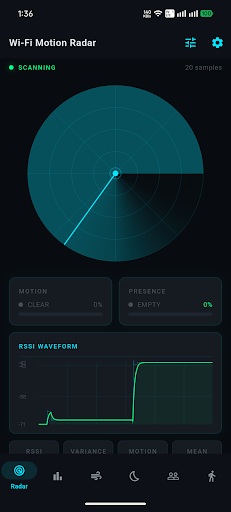
• Radar — animated sweep, heatmap, motion history timeline
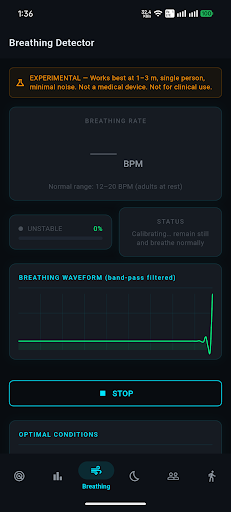
• Breathing — real-time BPM from 0.1–0.6 Hz band-pass filter
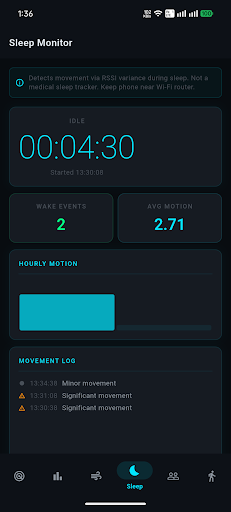
• Sleep — overnight restlessness tracking and hourly chart
• Walking — stride-frequency detection, steps/min via gait FFT
• People Counter — estimates 0–4+ occupants from variance
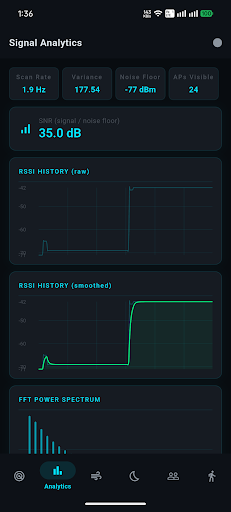
• Analytics — FFT spectrum, SNR, scan rate, CSV export
• Calibration — guided baseline calibration saved on-device
Important Limitations:
• Cannot identify WHO moved (person, pet, object)
• Cannot determine WHERE movement occurred
• Cannot measure distance to motion
• Subject to false positives from interference
• Accuracy varies by environment and wall materials
• Android limits Wi-Fi scan frequency
Privacy First:
• No camera or microphone access
• No data collection or transmission
• All processing 100% on-device
• No tracking, no analytics
• Works completely offline
Requirements:
• Android 8.0 or higher
• Physical Android device (emulator not supported)
• Wi-Fi enabled with at least one nearby access point
• Location permission (required by Android for Wi-Fi scanning)
Best For:
• Educational demonstrations of Wi-Fi physics
• Experimental motion and presence sensing projects
• Privacy-preserving occupancy detection
• Research into RF signal processing
SenseWave demonstrates Wi-Fi sensing principles using standard Android APIs. It is a learning tool and experiment — not a security system. Results vary based on environment, wall materials, and signal conditions.
Perfect for students, researchers, hobbyists, and anyone curious about Wi-Fi technology and signal processing!
EXPERIMENTAL SYSTEM — For education and research
How It Works:
• Monitors Wi-Fi signal strength (RSSI) in real-time
• Detects fluctuations caused by movement through the signal path
• DSP pipeline: Butterworth filtering + FFT + variance analysis
• No camera required — completely passive, privacy-safe sensing
7 Detection Modes:
• Radar — animated sweep, heatmap, motion history timeline
• Breathing — real-time BPM from 0.1–0.6 Hz band-pass filter
• Sleep — overnight restlessness tracking and hourly chart
• Walking — stride-frequency detection, steps/min via gait FFT
• People Counter — estimates 0–4+ occupants from variance
• Analytics — FFT spectrum, SNR, scan rate, CSV export
• Calibration — guided baseline calibration saved on-device
Important Limitations:
• Cannot identify WHO moved (person, pet, object)
• Cannot determine WHERE movement occurred
• Cannot measure distance to motion
• Subject to false positives from interference
• Accuracy varies by environment and wall materials
• Android limits Wi-Fi scan frequency
Privacy First:
• No camera or microphone access
• No data collection or transmission
• All processing 100% on-device
• No tracking, no analytics
• Works completely offline
Requirements:
• Android 8.0 or higher
• Physical Android device (emulator not supported)
• Wi-Fi enabled with at least one nearby access point
• Location permission (required by Android for Wi-Fi scanning)
Best For:
• Educational demonstrations of Wi-Fi physics
• Experimental motion and presence sensing projects
• Privacy-preserving occupancy detection
• Research into RF signal processing
SenseWave demonstrates Wi-Fi sensing principles using standard Android APIs. It is a learning tool and experiment — not a security system. Results vary based on environment, wall materials, and signal conditions.
Perfect for students, researchers, hobbyists, and anyone curious about Wi-Fi technology and signal processing!
Meer tonen
OTHERS:TOOLS
Wat is er nieuw in versie 1.3.5
Laatst bijgewerkt op May 27,2026
Kleine bugfixes en verbeteringen. Installeer of werk bij naar de nieuwste versie om het uit te proberen!
Minder tonen
Schermafbeeldingen
Informatie
-
Bijgewerkt2026-05-27
-
Huidige Versie1.0.1
-
Aangeboden door

-
Apk-grootte0MB
-
Vereist AndroidAndroid 4.4+